LiveTruly.com

Life, Books, and Adventures

Books

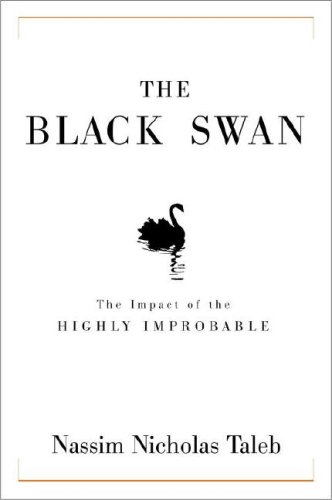
The Black Swan by Nassim Nicholas Taleb

Posted by b On November - 9 - 2008

The Black Swan: The Impact of the Highly ImprobableThe Black Swan by Nassim Nicholas Taleb is one of those books that can completely change the way you see the world. It talks about the unknown unknown, the black swan, the highly improbable unpredictable event that changes the world and which we will we later try to explain away.

You believe all swans are white. Each time you see a white swan, it’s just confirmation of your belief. People can see millions of white swans, but it only takes one black swan to prove everything wrong.

I first heard of this book on Talk of the Nation’s Interview with Taleb, it stayed in my mind throughout my adventures in Thailand, and upon my return I finally got my hands on a copy and fell in love with it.

Here are some of the topics covered (not a complete nor ordered list, nor exact quotes, just general highlights of parts I loved):

1. Mundanistan vs Extremistan: Take a 10,000 people to a stadium. No matter how fat one guy is, he’s not going to change the average weight by any noticeable amount. Same with height. Same with age. Now imagine you’re measuring net worth. A guy like Bill Gates will blow the average out of the stadium. Measures like height, weight, etc are from Mundanistan. Measures like net worth, people killed in a war or by a disease, the impact of a new invention etc, are from Extremistan. Averages and standard deviations and predictions can fail in Extremistan. For the most part…. we live in Extremistan… and we shouldn’t depend on Mundanistan prediction methods on things that can have huge impacts on our lives.

2. Silent Evidence: “These souls prayed to the gods and were saved.” “What about those who weren’t?” Most interesting professions, like writing or trading etc have huge cemeteries. When we look at the winning record of associates at a firm, or books sales, or even the stock picks of the latest hot fund, there’s a lot we don’t see. What about all the guys who are fired each year? What about all the authors who fail? What about all the companies that went bust and were replaced? Or the funds that were hot that no longer are? We often read books by successful CEOs listing the qualities they think made them get there (I’m particularly guilty), but we don’t see the thousands who have those same qualities who failed.

3. The Ludic Fallacy: Mistaking the map for the terrain. Best illustrated with the help of Fat Tony.

Thought experiment at a bar (this isn’t an exact quote, sounded much better in the book):
Taleb: I tossed a fair coin 99 times and got heads each time. What are my odds of heads on the next toss?
Dr. John (the actuary): 50/50.
Fat Tony: At least 99 to 1.
Dr. John: But why? The previous tosses have nothing to do with the next one.
Fat Tony: You’re either full of crap or a pure sucker to buy that fifty percent business. The coin’s gotta be loaded.

In other words: it’s more likely there’s something wrong with the assumption of fair play than a fair coin landing 99 times in a row on heads.

Further examples of this are in how we deal with probability. Most people think of probability as chances in dice and card games, but as one example points out: what were some of the biggest losses a casino had to deal with? A tiger attack on one of the Casino’s top performers, a pissed off contractor trying to dynamite the foundation columns, an employee filing papers that needed to be filed with IRS only in files in his own desk, and a kidnapping of the owner’s daughter. Think outside the box. There are many more things we don’t know than we know.

4. Induction: Don’t be the turkey!
Turkey wakes up every morning and gets fed and cared for by humans. It’s been true for 999 days. But on the 1000th day, there’s a very unpleasant surprise. Induction can be deadly.

5. Ties and Mice and Experts
Just because someone speaks with authority, has a suit on, and has a fancy position doesn’t mean you should trust him (or her). Next time you deal with a self-assured expert (political analyst, fancy academic, economist, etc) imagine dropping a mouse down his shirt and seeing his reaction. I was crying from laughter during the first detailed elaboration.

6. Survival Bias: Why didn’t the Plague kill more people? Because we’re still here. If it did, we wouldn’t be here asking. Casanova had his lucky star that he believed helped him back up. How could he bounce back so many times? Well, he might have, but thousands of other Casanova’s didn’t. You’re not hearing from them. Sitting next to a guy at a Casino, who just won some 1 to 100,000 prize. “It has to be destiny. I mean look at the chances.” Yeah, look at them, there were 999,999 others who failed. Don’t ask how could it be that you got here, but think of all the minor things that could have made you not be here. (Similar to 2. Silent evidence.. they’re all inter-related)

7. Butterflies and Chaos and Discoveries: They cleaned all the bird poop off the satellite, but the noise was still there. Turns out those noises were from the birth of the universe. They were just getting rid of bird crap. The guys that deduced those signals should exist had to read about the noise from the paper. Ditto for penicillin, another accident. Heck, ditto for Columbus and America. Big discoveries often happen when people are looking for something else. The weather simulator gave completely different results for the same input. A bug? No, it was from rounding some really small, super-tiny, unimportant number. The so-called butterfly causing a hurricane… two years later. But here’s the thing, this is not an invitation to analyze butterflies! The point is, in highly complex systems, minor measurements can completely change the results. The whole point is it’s extremely difficult to predict.

8. Diaries and Noise:
Instead of rebuilding memory and answers to suit events, keep a diary, with your predictions and analysis. Much more humbling. Interestingly, regarding news and info (and going well with Ferris’ low information diet): more information can hurt your performance. Take a fire hydrant and blur it. Now unblur it in a number of steps, say 20 for Group 1, and 10 (corresponding to each second unblur) of the previous group. If we stop at each common unblur and ask both groups if they recognize it, the group with just 10 steps would see it at an earlier step than the group with 20. More data, slower recognition. Ditto for investing, perhaps computers can run on nanosecond algorithms however, for people, this can create a lot of confusion, stress, and wasted effort. In addition to being blinded, we’re wired to make connections and see stories. They make memory doable, but the “because” isn’t a fact. Niederhoffer also stressed this in his books (Education of a Speculator, Practical Speculation) in regards to financial news headlines. Interestingly enough, he also avoids the news… except for the National Inquirer.

9. Anti-Platonicity: I whine about categories enough. The book does too.

10. More more and more:
These are just a few of the things covered in the book, others include fractals, a simple overview of black swan investing strategy (only minor but very interesting), surprising praise of army analysts, wonderful treatment of self-confident academics and professionals and high brow opera culture, anecdotes, scientific and philosophical references, different modes of reasoning, exposing oneself to opportunities, linguistic mistakes that cost us bigtime! All told in a down to earth, understandable, funny, very funny voice.

This should be required reading before entering college. It could help raise many interesting questions. The induction part, actually highlights a really interesting point in writing persuasive essays on standardized tests (my favorite subject to teach)… using single examples, the narrative, isn’t the logical/scientific way to prove stuff… although it’s very effective for its given purposes (getting into college, getting a higher score… or to get viewers for news-stories news headlines).

I actually didn’t read the book, I listened to it… twice. It’s the perfect journey book, on drives from SF to SJ, I sometimes ended up sitting in the car minutes after arriving to get the last morsel from the chapter. Some neat books that gave background to this read: Niederhoffer’s Education of a Speculator and Practical Speculation, Ariely’s Predictably Irrational, and Tim Ferriss’s The 4-Hour Workweek. I think the direct link between the interview and getting the books was probably from Daily Speculations. In any case, The Black Swan is a must read, a book that can change the way you see the world.

Two articles worth reading:
Blowing Up: How Nassim Taleb turned the inevitability of disaster into an investment strategy (2002)
Nassim Nicholas Taleb: the prophet of boom and doom (2008)

The 4-Hour Workweek

Posted by b On September - 12 - 2008

The 4-Hour Workweek: Escape 9-5, Live Anywhere, and Join the New Rich I found out about The 4-Hour Workweek while reading a random Men’s Journal article. So far it has been fantastic. It has Q&A (Questions and Actions and expands on many concepts from Rich Dad, Poor Dad.

I especially appreciate the sheets you can download from his website (fourhourworkweek.com) and high speed push toward efficiency and figuring out what you really want… ie. not a sum of money… but what you’d actually do with it. It was really surprising when I asked quite a few people what they would do if they had all the money and time they wanted that they really had no clue. They never thought beyond the money/time part. What Timothy Ferriss does is make you ask the right questions and take the necessary steps before it’s too late. Lifestyle design should be a required subject.

You Can Be a Stock Market Genius Even if You're Not Too Smart: Uncover the Secret Hiding Places of Stock Market Profits You Can Be a Stock Market Genius Even if You’re Not Too Smart: Uncover the Secret Hiding Places of Stock Market Profits is another common sense meets sophisticated investing book by Greenblatt. I love this guy. This book looks at certain situations where an individual investor has an advantage (if he does his research… or her research). He goes over the basics and then gives some case studies. This book is from the mid-90’s, but I think, as far as investing goes it’s really the most educational one I’ve read. Graham’s Security Analysis might have more details, but its very dense reading, very worthwhile but slow to sink in–at least for me. This book on the other hand reads faster than a motivational tape! It’s written in the same funny, no-nonesense, down-to-earth style as his little one. A major concept in this book is the win-to-loss ratio, ie. how much can you win vs. how much can you lose on an investment. He also goes through acquisitions, mergers, and all sorts of other situations that may at first be intimidating, but become fascinating after his hold-your-hand, pat-your-back walkthrough. I wish I could take some of his classes… maybe in a few years. By the way, the portfolio I started based on his website is in the double digits, even after the latest crash. Too bad it’s only a play one.

Freakonomics

Posted by b On December - 17 - 2006

Freakonomics [Revised and Expanded]: A Rogue Economist Explores the Hidden Side of Everything
Freakonomics is one crazy eye-opening book. I recently got it as a present from my old roommate. I really can’t think of anyone who wouldn’t benefit from reading this book. It’s a potent mix of history, policy, economics, and some statistics and how they all interact in very surprising ways. Told in an approachable, fresh, fun to read (or listen to) voice.

The part on glamor professions really hits a point. Thousands of people in lower positions competing for a very few spots. Those that make it, do very well, those are the ones seen, but most people don’t make it. If instead people went for a different goal, they could significantly increase their chances for success, or at the very least increase their standard of living while they try to achieve it. I also like how many events could be equally well or better “explained” by influences completely different than those that come to mind. Crime rate drops in a city with new police policies. Everyone cheers the mayor. Crime drops across the nation, regardless of policies. Was it because of the new policies? Was it due to some other event? Interesting question is how can we test these explanations.

Man’s Search For Meaning

Posted by b On December - 9 - 2006

Man's Search for Meaning
Frankl’s Man’s Search for Meaning is about finding your reason to live. Sometimes its not what you want from life, but what life demands from you. Frankl is a psychoanalyst who survived four concentration camps. Although it describes life in the camps in a very direct way, the book is more about finding the reason to keep going. It’s really direct and to the point and some passages of it flow like poetry. The book will have a different impact on every person. The edition I read had a long preface and a second part about logotherapy (logos = meaning). I found the original book and the last few pages the most powerful, although the whole thing is worth reading. This is the type of book that you could over and over and get more from it each time.

Who Moved My Cheese?

Posted by b On October - 30 - 2006

Who Moved My Cheese? Just read Who Moved My Cheese? by Dr. Spencer Johnson. It really illustrates the need to adapt, change, and not get lazy and start feeling entitled. Basically it’s about two mice and two mini-people that find a giant warehouse of cheese. The cheese is everything they want and they’re super happy (security, healthy relationships, money, power, etc). One day the cheese disappears. The mice hunt for another place but the people that got used to the place just get sad. One of the people eventually gets tired of waiting for the cheese to come back and goes hunting again… and finds greater treasures. A real metaphor for ife. The only catch I see is sometimes it does take a little persistence for something to develop, but I can see this as part of the hunt too. You got to get out and get violent (and persistent) to find the cheese. Who Moved My Cheese? is a really simple story with huge lessons. Definitely worth a read.

The book has a website too: whomovedmycheese.com