Live Truly

Life, Books, and Adventures

The Black Swan by Nassim Nicholas Taleb

Posted by b On November - 9 - 2008

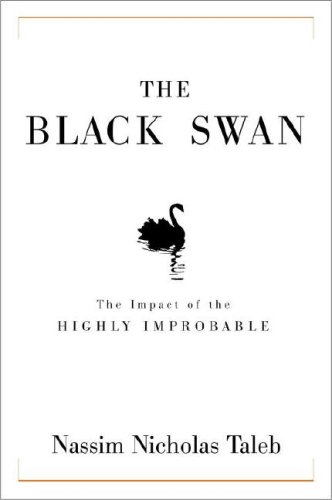
The Black Swan: The Impact of the Highly ImprobableThe Black Swan by Nassim Nicholas Taleb is one of those books that can completely change the way you see the world. It talks about the unknown unknown, the black swan, the highly improbable unpredictable event that changes the world and which we will we later try to explain away.

You believe all swans are white. Each time you see a white swan, it’s just confirmation of your belief. People can see millions of white swans, but it only takes one black swan to prove everything wrong.

I first heard of this book on Talk of the Nation’s Interview with Taleb, it stayed in my mind throughout my adventures in Thailand, and upon my return I finally got my hands on a copy and fell in love with it.

Here are some of the topics covered (not a complete nor ordered list, nor exact quotes, just general highlights of parts I loved):

1. Mundanistan vs Extremistan: Take a 10,000 people to a stadium. No matter how fat one guy is, he’s not going to change the average weight by any noticeable amount. Same with height. Same with age. Now imagine you’re measuring net worth. A guy like Bill Gates will blow the average out of the stadium. Measures like height, weight, etc are from Mundanistan. Measures like net worth, people killed in a war or by a disease, the impact of a new invention etc, are from Extremistan. Averages and standard deviations and predictions can fail in Extremistan. For the most part…. we live in Extremistan… and we shouldn’t depend on Mundanistan prediction methods on things that can have huge impacts on our lives.

2. Silent Evidence: “These souls prayed to the gods and were saved.” “What about those who weren’t?” Most interesting professions, like writing or trading etc have huge cemeteries. When we look at the winning record of associates at a firm, or books sales, or even the stock picks of the latest hot fund, there’s a lot we don’t see. What about all the guys who are fired each year? What about all the authors who fail? What about all the companies that went bust and were replaced? Or the funds that were hot that no longer are? We often read books by successful CEOs listing the qualities they think made them get there (I’m particularly guilty), but we don’t see the thousands who have those same qualities who failed.

3. The Ludic Fallacy: Mistaking the map for the terrain. Best illustrated with the help of Fat Tony.

Thought experiment at a bar (this isn’t an exact quote, sounded much better in the book):
Taleb: I tossed a fair coin 99 times and got heads each time. What are my odds of heads on the next toss?
Dr. John (the actuary): 50/50.
Fat Tony: At least 99 to 1.
Dr. John: But why? The previous tosses have nothing to do with the next one.
Fat Tony: You’re either full of crap or a pure sucker to buy that fifty percent business. The coin’s gotta be loaded.

In other words: it’s more likely there’s something wrong with the assumption of fair play than a fair coin landing 99 times in a row on heads.

Further examples of this are in how we deal with probability. Most people think of probability as chances in dice and card games, but as one example points out: what were some of the biggest losses a casino had to deal with? A tiger attack on one of the Casino’s top performers, a pissed off contractor trying to dynamite the foundation columns, an employee filing papers that needed to be filed with IRS only in files in his own desk, and a kidnapping of the owner’s daughter. Think outside the box. There are many more things we don’t know than we know.

4. Induction: Don’t be the turkey!
Turkey wakes up every morning and gets fed and cared for by humans. It’s been true for 999 days. But on the 1000th day, there’s a very unpleasant surprise. Induction can be deadly.

5. Ties and Mice and Experts
Just because someone speaks with authority, has a suit on, and has a fancy position doesn’t mean you should trust him (or her). Next time you deal with a self-assured expert (political analyst, fancy academic, economist, etc) imagine dropping a mouse down his shirt and seeing his reaction. I was crying from laughter during the first detailed elaboration.

6. Survival Bias: Why didn’t the Plague kill more people? Because we’re still here. If it did, we wouldn’t be here asking. Casanova had his lucky star that he believed helped him back up. How could he bounce back so many times? Well, he might have, but thousands of other Casanova’s didn’t. You’re not hearing from them. Sitting next to a guy at a Casino, who just won some 1 to 100,000 prize. “It has to be destiny. I mean look at the chances.” Yeah, look at them, there were 999,999 others who failed. Don’t ask how could it be that you got here, but think of all the minor things that could have made you not be here. (Similar to 2. Silent evidence.. they’re all inter-related)

7. Butterflies and Chaos and Discoveries: They cleaned all the bird poop off the satellite, but the noise was still there. Turns out those noises were from the birth of the universe. They were just getting rid of bird crap. The guys that deduced those signals should exist had to read about the noise from the paper. Ditto for penicillin, another accident. Heck, ditto for Columbus and America. Big discoveries often happen when people are looking for something else. The weather simulator gave completely different results for the same input. A bug? No, it was from rounding some really small, super-tiny, unimportant number. The so-called butterfly causing a hurricane… two years later. But here’s the thing, this is not an invitation to analyze butterflies! The point is, in highly complex systems, minor measurements can completely change the results. The whole point is it’s extremely difficult to predict.

8. Diaries and Noise:
Instead of rebuilding memory and answers to suit events, keep a diary, with your predictions and analysis. Much more humbling. Interestingly, regarding news and info (and going well with Ferris’ low information diet): more information can hurt your performance. Take a fire hydrant and blur it. Now unblur it in a number of steps, say 20 for Group 1, and 10 (corresponding to each second unblur) of the previous group. If we stop at each common unblur and ask both groups if they recognize it, the group with just 10 steps would see it at an earlier step than the group with 20. More data, slower recognition. Ditto for investing, perhaps computers can run on nanosecond algorithms however, for people, this can create a lot of confusion, stress, and wasted effort. In addition to being blinded, we’re wired to make connections and see stories. They make memory doable, but the “because” isn’t a fact. Niederhoffer also stressed this in his books (Education of a Speculator, Practical Speculation) in regards to financial news headlines. Interestingly enough, he also avoids the news… except for the National Inquirer.

9. Anti-Platonicity: I whine about categories enough. The book does too.

10. More more and more:
These are just a few of the things covered in the book, others include fractals, a simple overview of black swan investing strategy (only minor but very interesting), surprising praise of army analysts, wonderful treatment of self-confident academics and professionals and high brow opera culture, anecdotes, scientific and philosophical references, different modes of reasoning, exposing oneself to opportunities, linguistic mistakes that cost us bigtime! All told in a down to earth, understandable, funny, very funny voice.

This should be required reading before entering college. It could help raise many interesting questions. The induction part, actually highlights a really interesting point in writing persuasive essays on standardized tests (my favorite subject to teach)… using single examples, the narrative, isn’t the logical/scientific way to prove stuff… although it’s very effective for its given purposes (getting into college, getting a higher score… or to get viewers for news-stories news headlines).

I actually didn’t read the book, I listened to it… twice. It’s the perfect journey book, on drives from SF to SJ, I sometimes ended up sitting in the car minutes after arriving to get the last morsel from the chapter. Some neat books that gave background to this read: Niederhoffer’s Education of a Speculator and Practical Speculation, Ariely’s Predictably Irrational, and Tim Ferriss’s The 4-Hour Workweek. I think the direct link between the interview and getting the books was probably from Daily Speculations. In any case, The Black Swan is a must read, a book that can change the way you see the world.

Two articles worth reading:
Blowing Up: How Nassim Taleb turned the inevitability of disaster into an investment strategy (2002)
Nassim Nicholas Taleb: the prophet of boom and doom (2008)

Rich Dad, Poor Dad

Posted by b On January - 17 - 2006

Rich Dad, Poor DadRobert Kiyosaki’s Rich Dad, Poor Dad isn’t just about money, it’s about life. His dad, an educated PhD, a successful and respected academic official, spent most of his life struggling to find time and to get by financially. He was successful, but there was never enough time and never enough money. His friend’s dad never finished high school, but managed to build a financial empire. When he was a little kid, he asked his dad how to get rich. When “making money” led him and his buddy to melting lead toothpaste tubes, both their fathers were happy with the initiative, but suggested he study from the future millionaire about how to get there. This book flipped my world view. Before I read it, I never thought about my path in life. I just figured I’ll get a good degree, get a decent job, become better at it, and try to enjoy my weekends and hours after work. This book reveals, in very powerful and simple terms, that the difference between rich and poor is that the rich let money work for them and the poor work for their money. It’s very eye opening stuff.

The story started almost half a year ago. Not far from when I started my web development internship. My dad set an anchor for learning Spanish and, right on time, a new guy joined his company–fluent speaker, with software in the language. He also let my dad listen to some tapes called “Rich Dad Poor Dad

At the dinner table:
Dad: “Say you need some extra cash, what do most people do? What’s the most logical thing to do?”
B: “Get another job?”
D: “That’s what most people say. But it’s absolutely the wrong answer. To really make it, you shouldn’t work two jobs, you need to start your own business. A business can grow and make you more money, but working that second job, you’ll just be wasting your time. You won’t be getting any better at it, advancing, or getting well paid. It’s just not worth it.”

I liked this idea. Both my parents work two jobs. They make decent money, but end up stuck in the same situation, working to exhaustion and worrying about losing their jobs. Making almost nothing with the internship and learning even less, I started thinking about what to do. I realized this job was leading nowhere and perhaps school wouldn’t be so bad. I needed to study for the GRE’s or the GMAT. Since I’ll be studying, why not start a business as I do it. Tutor kids in SAT’s and practice my own stuff at the same time. It would pay just as much for like a half or third the time I spend at work, and it’d be time well spent.

For about a week I searched for a desk on craigslist. Coming home tired, I’d just look for an hour or so, then crash. One night I just had enough. I was just going to go buy a new one. It would be an investment, a place where my students would study. I ran out of the house to buy the perfect desk at Target, from the Metropolitan Collection. Sleak, simple, and comfy and tall. (Sorry for the tangent, I’m quite a fan of interior design.)

After one final check for responses to my desk inquiries, I was out the door. Right as it closed I remember the faceplace to my CD-player. I go back in and switch it with my keys and head out again. Again, I realize the keys are gone right as the door clicks locked. With my roomate out for the day and a spare car key in my wallet, the journey began.

I got the desk. Oh, so lovely. But now what? With no way to get into my place and nowhere nearby to go, why not hit up a book store? I drove the desk over to Borders and somehow ended up picking out that book. I finished a third by the time the store closed.

All my training, my programming, my getting programmed. It finally dawned on me. What am I going to do to make it? I couldn’t put down this book. It’s like picking up a manual on your life. Not just some VCR manual, but a fun one, written in real words, by real people, and about you. I just couldn’t stop.

After the store closes, I read another hour in my car, but realizing that it’ll get too cold to sleep there, I call up J, a buddy in the Mission. Just a few weeks back, my roomate and I stopped by J’s place for a chat. Back in the days, J and I would carpool to math classes at the local high school and were micro-community presidents, in high school we were both programming nerd and took classes at the JC with my dad. Toward college, we didn’t kick it as much, although I’d end up at a bunch of political rallies with his mom. He was a contractor for Y2K stuff and a waiter, while I worked at the library. He started college a semester before me, and by the time I started, he joined a frat. I joined some atheist group. Eventually realizing what a waste of time it was, I evolved to a dance group. By this time he took on a job at the Computer Center. He ran the house budget and then ran the house, while I took summer school. He eventually chose Cog Sci, and I followed in his tracks. By the time I followed him to becoming an advisor, he went to study business in Spain. While I grunted through my last year, he took a trip to Peru to teach and raise funds for an orphanage in Peru. By the time I was done with Cal, he’d joined an internet company and worked his butt off. He had a powerful work ethic and a very strong personal and leadership skills and I had only respect for him. And tonight, he saved me from the cold (the desk could take it).

That night, as he and the girl he met on match.com had some fun in his room, I kept reading the book. Around three, a few friends came back from the bars and crashed in the living room too. I took a nap and went into the bathroom to keep reading. Around six, his roommates came back from the clubs. This whole time I was reading. I couldn’t stop until I finished. I finished around six in the morning. I can’t describe what’s in the book. The first few chapters take all the things you learn in school and flip them on their head. It’s just amazing.

Reading this book was one of the biggest turning points in my life. It shook me up and made me realize that I need really sit down and really think about how I want to live my life. While this book isn’t a clear formula, it’s a big wake-up call and should be mandatory reading for people going into high school. I wish I read it then.